

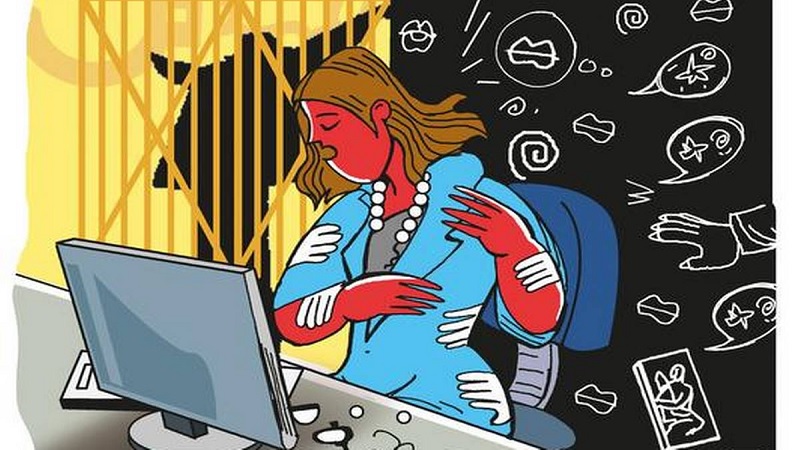
It is more than two decades since the Supreme Court passed a landmark judgment in the case of Vishakha Vs. State of Rajasthan AIR 1997 SC 301. formulate the famous ‘Vishakha guidelines’, which provide guidance for the resolution of complaints through internal complaint mechanisms in the cases of sexual harassment at the workplace.
Following which the central and state governments are recommended to adopt legislation assuring employers particularly. Sadly in 2013, when the Nirbhaya case resulted in a massive outcry for justice.
The central government was forced to enact the Sexual Harassment of women at the workplace (Prevention, Prohibition and Redressal) Act.It commonly referred to as POSH,amongst thriving reforms intending to address sexual violence against women.
Despite the introduction of legislative reforms and Vishakha guidelines shows the unchanging standards and procedures of law.
However, Rule 7 of the Sexual Harassment of Women at Workplace provides the party entitled to legal representation.Whereas, the High Courts have a different view on cross-examining the complainant indirectly.
On the contrary, the Supreme Court held the right of the respondent to cross-examine the complainant indirectly along with the witness of the later.Through a written questionnaire in lieu of verbal cross-examination as in the case of Bidyut Chakraborty Prof. Vs. Delhi University & others.
Nowadays, no rape shield safeguards are available under the POSH Act. Unlike the provision under Section 114 A (presumption of absence of consent in certain cases) and Section 146 (prohibition of questions relating to the immoral character of a prosecutrix) of the Indian Evidence Act 1872.It further provides an opportunity for the internal committees to use traditional standards of criminal law on sexual harassment.
However,the complainant’s ordeal may aggravate the case in which the respondent appeals to the High Court. It is obvious that the complainant’s testimony is subjective as to internal proceedings.
Recent amendment on sexual harassment
Recently, a Division Bench to the Uttarakhand High Court passed progressive judgment in reference to Bhuwan Chandra Pandey Vs. Union of India.The case is a writ petition which challenges the order for dismissal against the petitioner, an employee of Shashtra Seema Bal Officer (SSB).Subsequently, the respondent threatened the trainee to withdraw the case. As the respondent was a senior officer and also his father was a DIG in the SSB then.
Internal inquiry committee has found the petitioner guilty of the charges in 2001. The case suffered multiple stages of litigation due to procedural deficiencies. The findings sustained disciplinary authority that admit the order of dismissal, the Union Public Service Commission, and the Ministry of Home Affairs.
Though the complainant’s testimony was confirmed by another woman trainee along with other senior officers present at incident . The petitioner argued that her testimony alone will not form the basis for holding the perpetrator guilty.
In subsequent, the court ruled rape law jurisprudence to hold the sole testimony of the complainant. It would suffice an internal or departmental inquiry of sexual harassment and molestation cases, alike in criminal cases.
If evidence rules overconfidence, there is no need to confirm the testimony in material particulars. The Indian Evidence Act does not govern the departmental inquiry or disciplinary proceeding.
Validity of proofs
The standard proof requires simply that of ‘preponderance of probabilities’ and further admit its credibility and reasonable nexus to the case. Moreover, the court cannot reassess the findings of the internal authority.
In addition, the petitioner argued the fallacy in the verdict of the case.Since the complainant’s committee comprised of female officers subordinate to the respondent.
In conclusion, it is worth considering whether it would be appropriate to delegate the internal inquiry. The process under POSH to a more autonomous body to avoid a miscarriage in delivering justice in judiciary practices.